What renovating a clinic taught me about patience, persistence and the importance of seeing beyond
the surface.
After more than three decades spent rebuilding and restoring the human body, Dr Rozina Ali might
reasonably have expected that renovating a building would be relatively straightforward. But
creating her new R&A Clinic in South Kensington proved to be an education of an entirely different
kind. Now, several weeks after opening its doors, she reflects on the extraordinary journey from
building site to beautiful new home for regenerative aesthetics, and the moments when a crack in
the plaster seemed to sum it all up.
I’ve spent much of my professional life in operating theatres, working with some of the most
intricate structures in the human body. I’ve reconstructed breasts, transferred tissue from one part
of the body to another and spent countless hours restoring form and function. I’m comfortable with
complexity, accustomed to making difficult decisions and rather fond of a challenge.
So when I decided to create my own clinic, how difficult could it really be?
Well…
Several weeks into welcoming patients to R&A, I can finally look around this beautiful space and
enjoy what we’ve created. The treatment rooms are ready, the technology is in place, the team is
here, and the vision I’ve carried around in my head for years has become somewhere real.
Somewhere warm, welcoming and rather lovely.
But there were moments during the renovation when I stood in the middle of the building, staring at
cracks in the plaster, wondering quite how I’d got myself into this. And, more importantly, how on earth I was going to get myself out.
From operating theatre to building site
It took me five years to find the right premises for R&A, another 18 months to secure them, and a
considerable amount of determination to get the project off the ground. When I finally had the keys
to our beautiful building in South Kensington, I thought the worst was over.
How charmingly naïve.
I’d never undertaken more than home renovation before, with a very friendly builder. I knew how to
reconstruct people and homes, not how to complete a commercial project. I had absolutely no idea
how to find a building company, project manager, quantity surveyor. I assumed there must be
people who knew exactly what to do, and that all I needed was to find them. So naive.
There were delays, frustrations, unexpected obstacles (electric cable drilled through, asbestos
found) and moments when I seemed to have become the project manager, site supervisor and chief
administrator.
And there were days when I found myself simply staring at the trench in the floor, the wood frame
partitions, the ceiling trays carrying cabling- it was like vascular surgery and orthopaedics all
wrapped up in one!
The frustrating thing was that I could see the finished clinic so clearly in my mind. I knew how I
wanted it to look, how it would feel, smell, sound. A beautiful sanctuary of peace, a place of joy and
fun, where clients could relax and feel safe and cared for. A functional emporium of pleasure, where
every room, every detail and every piece of technology had a purpose. Seriously good medicine in a
seriously pleasing environment.
As a reconstructive surgeon, I’ve long understood that form and function are inseparable. Something
can be beautiful, but it must also work. And the building itself had so much character. I loved its Art
Deco heritage and wanted to celebrate that, rather than lose it in the process of creating a state of
the art clinic. The challenge was to preserve its personality while transforming it into a space that
could accommodate sophisticated medical technology, beautifully designed treatment rooms and
the space to deliver exceptional patient care.
In many ways, that’s exactly how I approach aesthetic surgery. I don’t want to erase what makes
someone distinctive. I want to understand their underlying structure, respect their natural features
and make thoughtful changes that enhance rather than overwhelm. Seems to me, the best results,
whether you’re restoring a building or rejuvenating a face, come from preserving persona whilst you
modernise and rectify.
Of course, holding on to that bigger picture wasn’t always easy when the immediate picture involved
dust, delays and yet more cracks in the plaster.
Looking beneath the surface
One of my personal aphorisms in aesthetic medicine is that we must understand both the issues and
the tissues.
A wrinkle, a hollow or a change in facial shape is rarely just a surface problem, it reflects changes in
the fat, muscle, bone or supporting structures beneath the skin. 20 years of reconstructive training
has taught me to look beyond surface detail to understand the underlying functional anatomy and
only then decide what needs to be done.
During the darkest moments of the renovation, I found myself returning to that philosophy.
I’d catch myself staring at a crack in the plaster, wondering what it might tell me about what lay
beneath. Was it simply a superficial imperfection? Was there something more to understand? My
surgeon’s brain simply wouldn’t switch off.
But the cracks also became a useful reminder to look beyond the immediate frustrations. I hadn’t
embarked on this enormous undertaking because I particularly wanted to spend my days discussing
plaster, plumbing and building regulations. I was doing it because I believed there was a far better
way to bring together surgery, regenerative science, aesthetics, technology and wellbeing.
The building was the means, not the end. I needed to keep sight of what I was trying to create. In
surgery, you don’t abandon a reconstruction because one stage proves difficult. You reassess, adapt
and find another way forward. I began a war of attrition and every surgeon can tell you about our
training in siege mentality – approach doggedly from all angles!
And that’s what I did. When the renovation wasn’t progressing as it needed to, I changed the team,
took a fresh approach and got on with finishing the clinic to my satisfaction. What had felt like an unnecessary setback became a pivotal turning point. The place I’d imagined began to emerge from
the building site, it took grit, determination and meticulous attention to detail.
From cracks in the plaster to something rather beautiful
And now, here we are. R&A has been open for several weeks, and the experience of walking through
the doors is warm, welcoming and unabashedly happy. The building that once seemed to consist of
endless decisions, delays and dust has become the regeneration & aesthetics clinic I wanted to
create.
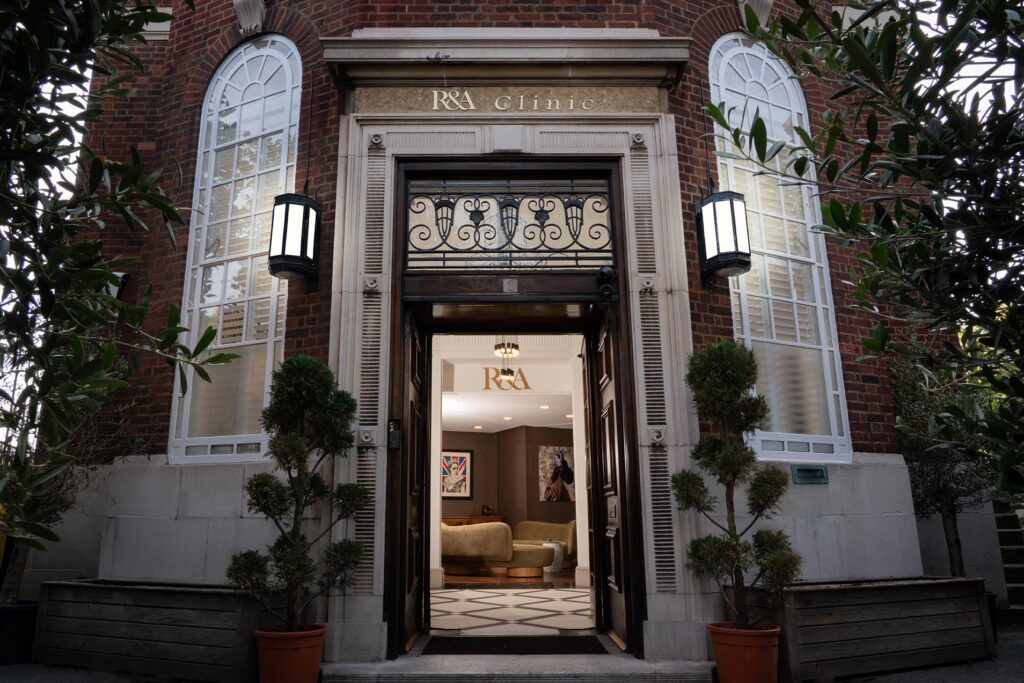
The Art Deco character that first drew me to the building has been preserved and celebrated, while
its interiors have been transformed into beautifully designed treatment rooms and welcoming public
spaces. It’s a place where sophisticated medical technology and serious clinical expertise sit
comfortably alongside warmth, elegance and a little indulgence. Exactly as I’d imagined.
But the real pleasure has been seeing the clinic come to life. Watching patients relax, hearing
conversations in the treatment rooms and seeing teams of aestheticians and doctors working
together reminds me why every difficult decision mattered. A building can be beautiful, but it’s the
function that is important, are the people within being happy and filled with purpose.
R&A is a place for regeneration, rejuvenation and renewal; it’s a place for best in class aesthetics. At
R&A we look beyond the surface, understand the individual and help people look well, feel well and
function well for longer. A place where people can relax and enjoy the experience, I believe being
happy counts for something.
I’ve learnt an extraordinary amount from creating R&A. About property, finance, contracts and
construction, certainly. But also about patience, persistence, the importance of surrounding yourself
with the right people. I’ve learnt about the remarkable capacity of a clear vision to keep you moving
forward, even when the immediate picture is rather less appealing.
Would I do it all again?
Ask me in another few months.
For now, I’m delighted to be back doing what I love, welcoming patients into a clinic that finally feels
like the home I imagined for them.
And if you happen to see me studying a wall with a slightly concerned expression, don’t worry. I’m
probably just admiring the underlying electrical cabling that I know the plaster covers!
Dr Rozina Ali is a consultant plastic, reconstructive and aesthetic surgeon and founder of R&A Clinic
in South Kensington, London. Her approach combines surgical expertise, regenerative science,
advanced technology and personalised care to help patients look, feel and function at their best for
longer.